



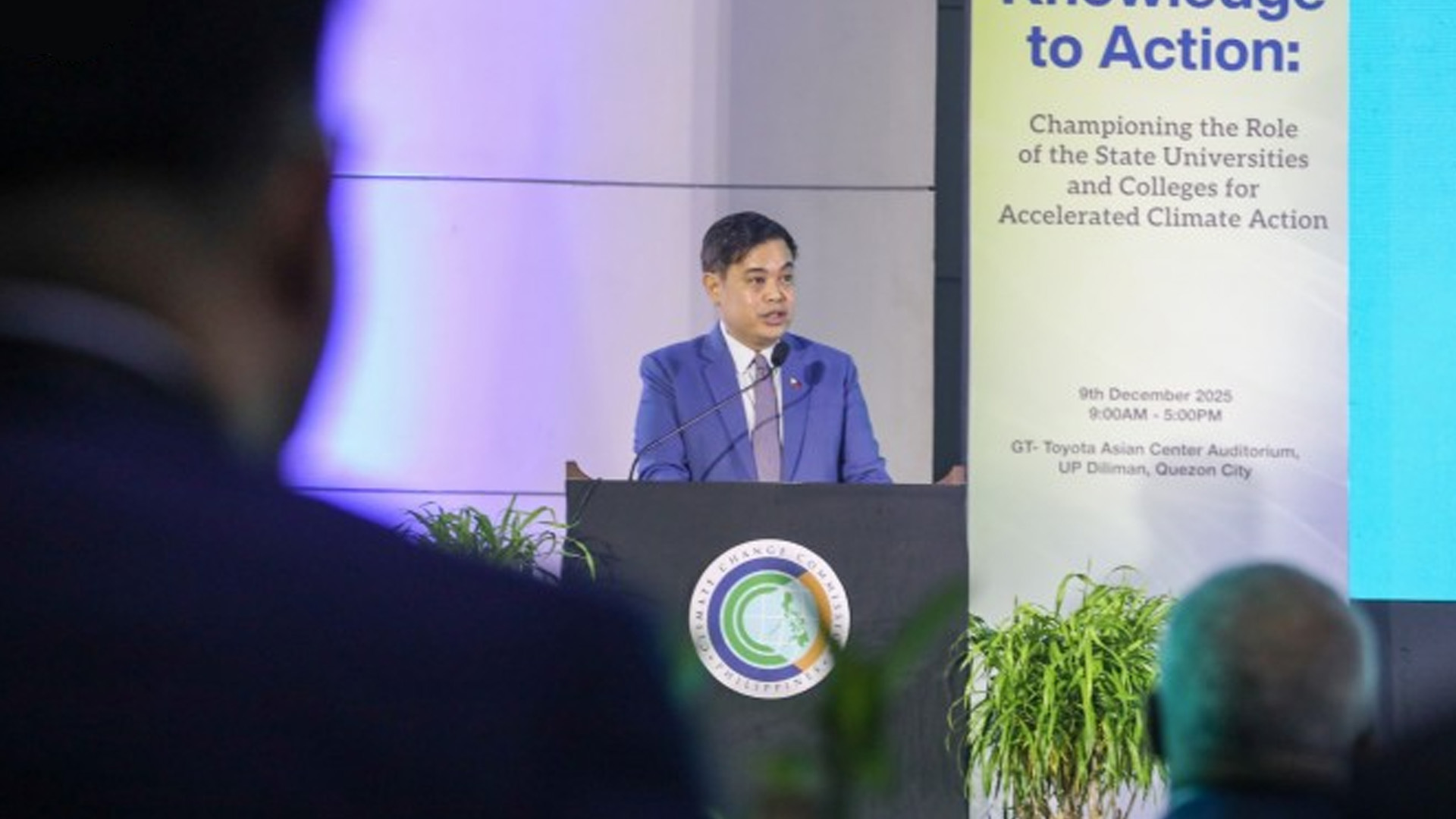







The Climate Change Commission (CCC) has called on State Universities and Colleges (SUCs) to take a central role in implementing and localizing the National Adaptation Plan (NAP), referring to them as the backbone of climate resilience.
At the Knowledge Exchange Forum on Tuesday, CCC Vice Chairperson and Executive Director Robert Borje said local government units (LGUs) and residents trust SUCs, and the partnership between them should be strengthened.
“We cannot and must not close our eyes to the important role of State Universities and Colleges. And I’ll be very frank, the reason why we want this is because we know that you play a key role in not just localizing the NAP, but the bigger vision is that our State Universities and Colleges play the key role of really strengthening the resilience of our communities,” he said.
“We have utmost respect for State Universities and Colleges officials because kayo po ang pinagkakatiwalaan ng ating mga LGUs. At bukod pa dun (our LGUs trust you. And aside from that), it is critical and important that you play a role because in the greater scheme of things, as what I’ve said earlier, you’re a strategic partner.”
Borje outlined five key priorities for SUC, including strengthening climate data systems, deepening SUC-LGU partnerships, applying futures thinking, scaling proven climate solutions, and improving access to climate finance.
Borje added SUCs could also help scale proven solutions like nature-based interventions, climate-smart agriculture, and resilient infrastructure, and ensure access to climate finance through technically sound proposals.
Meanwhile, Senator Loren Legarda, principal author of the Climate Change Act, also called for urgent, inclusive climate action with SUCs, highlighting the Philippines as the world’s most disaster-prone country and citing this year’s 23 typhoons.
She also warned that climate change could slash gross domestic product by 13.6 percent by 2040 if adaptation measures are delayed.
With this, Legarda challenged SUCs and higher education institutions to take leadership roles.
“Mainstream climate education across all disciplines —not as an elective, but as a core competency for every graduate. Establish Climate Innovation Hubs in every region. Lead by example —ensure that every campus activity, event, and operation is net zero, single-use plastic-free, and sustainability-driven. Serve as climate data and analytics centers for your regions,” she said.
Commission on Higher Education (CHED) Chairperson Shirley Agrupis, meanwhile, underscored the importance of translating climate knowledge into action.
She also concurred with Legarda that knowledge of climate change should not be confined to the classroom.
“I would like to emphasize that climate change really is an unpredictable disaster in our midst,” she said.
“In all aspects of our life, climate change plays a very crucial effect on our daily living, and the state universities and colleges play a very vital role.”
During the forum, the CCC, CHED, the Philippine Association of State Universities and Colleges, and the Union of Local Authorities of the Philippines signed a commitment to action to advance climate education, research, and LGU collaboration.
CCC Commissioner Rachel Herrera, meanwhile, said SUCs are the translators of climate science for communities.
She underscored the need to affirm the transformative role of academic institutions, adding that if people invest trust in climate resilient development, the returns will be measured not only in reports and in indicators, but in lives and livelihoods protected.
“You are more than educators. You are climate stewards, resilience builders, and future shapers. Let us move from knowledge to action. From planning to practice. From vulnerability to resilience,” Herrera told SUC officials. (PNA)